
The Challenge
For pet food manufacturers, the journey from frozen raw material to the production line can become a significant bottleneck.
Meat, poultry, organ meats, seafood and other protein ingredients are often received and stored as frozen blocks. Before grinding, mixing or further processing, these materials need to reach a suitable processing temperature.
Conventional thawing and tempering methods can require significant time and floor space. They can also result in uneven temperature distribution, with softened outer layers and frozen cores. This can make downstream processing less consistent and create challenges for grinding and production scheduling.
As pet food manufacturers expand their recipes and process a wider range of protein ingredients, there is an increasing need for faster, more uniform and controllable frozen food defrosting.
The RF Experience Centre Approach
The Strayfield RF Experience Centre provides a platform for manufacturers to evaluate Radio Frequency (RF) defrosting and tempering technology using their own products and process requirements.
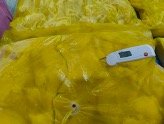
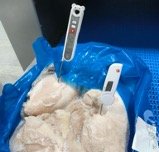
A series of RF trials were conducted on a wide range of frozen ingredients representative of those used in pet food manufacturing.
The objective was to evaluate the ability of RF technology to rapidly and uniformly temper frozen products to a controlled processing temperature, while assessing the potential throughput for industrial-scale production.
The trials targeted an average exit temperature in the range of -3°C to -1°C, depending on the product and process conditions.
The RF Defrosting Trial
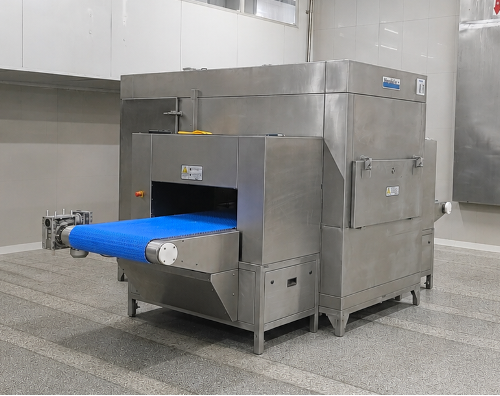
A Strayfield MagnaFrost 15 kW RF Defroster was configured with specially programmed operating parameters to gently and uniformly temper a diverse range of frozen pet food ingredients. The system was evaluated across multiple product categories commonly used in premium pet food manufacturing.
Products Evaluated
- Chicken breast
- Duck breast
- Chicken MDM
- Turkey breast
- Beef
- Deer meat
- Chicken liver
- Beef liver
- Chicken glandular stomach
- Pork lungs
- Beef lungs
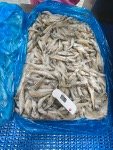
- Shrimp
- Whole sardine
- Fish surimi
- Salmon minced surimi
- Frozen milk
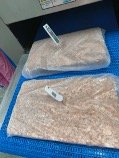
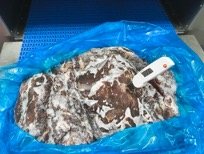
This demonstrated the versatility of RF tempering across poultry, red meat, seafood, organ meats, mechanically deboned meat, and dairy ingredients used in modern pet food formulations.
What Was Evaluated?
Each product was assessed under controlled RF processing conditions, with parameters adjusted according to product characteristics.
The evaluation considered:
- Initial product temperature
- Target exit temperature
- Block dimensions
- Product loading
- Conveyor speed
- RF power conditions
- Product throughput
- Uniformity of tempering
The Results
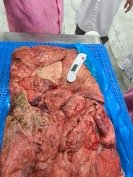
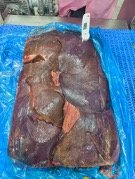
Across the evaluated products, frozen ingredients were processed from temperatures ranging from approximately -4°C to -13°C, with many products reaching an exit temperature within the target processing range of approximately -3°C to -1°C.
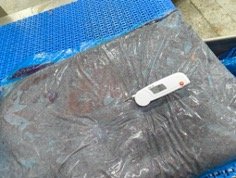
The trials demonstrated:
Uniform RF Tempering
RF energy penetrates the product, enabling volumetric heating and helping achieve more uniform tempering throughout frozen blocks.
Controlled Processing Temperature
Products could be brought closer to their target processing temperature without relying on prolonged conventional thawing periods.
Consistent Downstream Processing
Tempered material can be better suited for subsequent operations such as grinding and mixing, helping create a more consistent production flow.
Continuous Processing
The conveyor-based RF system allows frozen product to move continuously through the tempering process, supporting industrial production environments.
Throughput Potential
The application trials were also used to establish indicative throughput for larger-scale RF systems.
Based on the trial results, a 75 kW MagnaFrost RF Tempering System was selected for further engineering consideration.
Indicative production capacities included:
| Product | Indicative Throughput |
| Boneless chicken breast / duck breast / chicken MDM | Up to 1,700 kg/hr |
| Beef | Up to 1,500 kg/hr |
| Deer meat | Up to 1,500 kg/hr |
The above throughput figures are indicative and are based on the trial results. Final production capacity will be confirmed during the engineering process based on the specific product, input temperature and required exit temperature.
What This Means for Pet Food Manufacturers
RF tempering can help manufacturers address some of the key challenges associated with frozen raw material preparation.
Reduce Tempering Bottlenecks
Move frozen ingredients towards processing temperature faster, reducing the time raw materials spend waiting between cold storage and production.
Improve Production Flow
Create a more predictable transition from frozen storage → RF tempering → grinding → mixing → downstream processing.
Handle Multiple Protein Types
Process a broad range of poultry, red meat, organ meat, seafood and other ingredients using RF technology.
Support High-Throughput Production
Continuous conveyor processing and scalable RF systems can support the throughput requirements of growing pet food manufacturing operations.
Improve Process Control
RF parameters can be adjusted according to product characteristics and desired exit temperature, allowing manufacturers to develop a controlled tempering process.
Test Your Product at the Strayfield RF Experience Centre
Every frozen product behaves differently under RF processing.
Product composition, moisture content, fat content, block dimensions, packaging, initial temperature and target processing temperature can all influence the required RF parameters and achievable throughput.
That is why application testing matters.
At the Strayfield RF Experience Centre, manufacturers can evaluate their own frozen products under controlled RF conditions and assess:
- Suitable RF processing parameters
- Target exit temperatures
- Product throughput
- Block size and loading requirements
- Tempering uniformity
- Energy requirements
- Suitability for integration into the production line
From Trial to Production
Bring your product. Test the process. Validate the technology.
The RF Experience Centre helps pet food manufacturers move from laboratory or application trials to a production-ready RF tempering solution with process data to support equipment selection and engineering.